Research Project
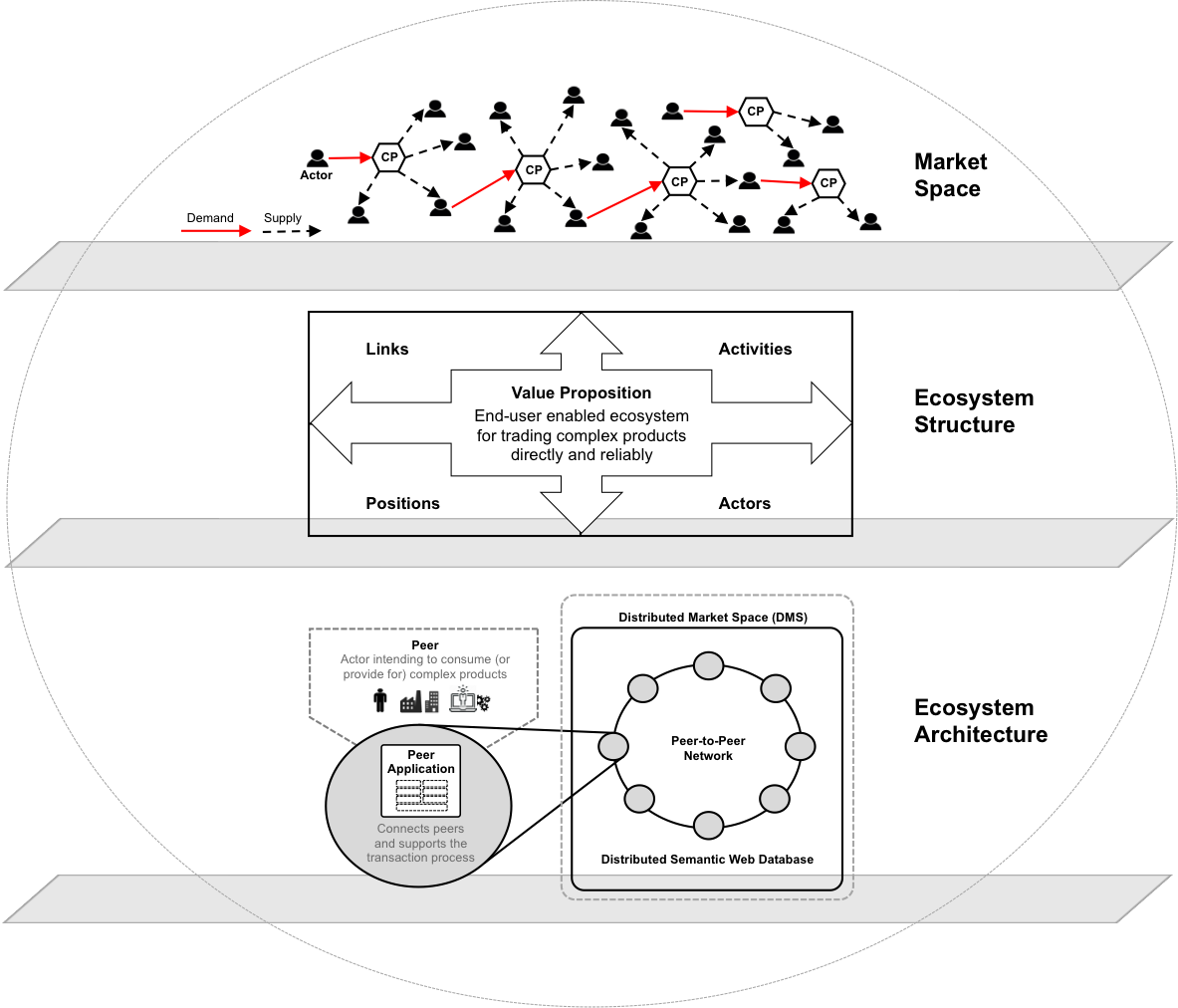
Abstract: Consumers looking for complex products, demand highly personalized combinations of individual products and services to satisfy a particular need. While online marketplaces work well for single products and services (or a predefined combination of them such as the combination of flight, hotel, rental car, and insurances), they fall short to support complex products. The complexity of finding the optimal product/service combinations overstrains consumers and increases the transaction and coordination costs for such products. Another issue related to contemporary marketplaces is the increasing concentration of supply around platform-based ecosystems such as, e.g., Amazon, Alibaba or eBay. That underpins the positional power of these platforms, putting them in the position, where they can dictate the rules and control access and offerings, and thus, leads to a de-facto centralization of the previously decentralized offerings on the Internet. To address these issues, we propose a novel business ecosystem model for complex products -- an ecosystem model that supports complex products in a way to lower transaction and coordination costs and which follows the principle of the disintermediation to alleviate the adverse effects of growing platform power.
Digital Business - Book Chapter
Shows the complex product description for the use case scenario: planning a perfect evening with friends. The complex product spans four different service domains (i.e., babysitting, gastronomy, parking, and ticketing) and has to consider contextual information regarding the schedule, location, and ratings of a particular service.
The implemented data model comprises triples describing registered providers for domains babysitting, gastronomy, parking, and ticketing.